
Copper Baseboard

Copper Baseboard Heating — Frequently Asked Questions
Common questions about copper baseboard convectors for hot water heating systems in Chicago
Q
Where can I buy copper baseboard heating in Chicago?
Consumers Supply Company at 1110 W. Lake St. in Chicago carries copper baseboard convectors for hot water heating systems. The store serves homeowners, building owners, and plumbing and heating contractors throughout the Chicago area. Walk-ins are welcome — call (312) 666-6080 to discuss your project and confirm availability before making the trip.
Q
What is copper baseboard heating and how does it work?
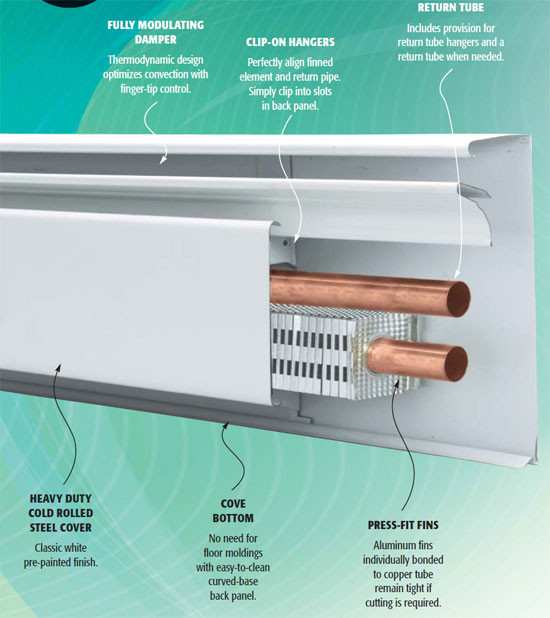
Copper baseboard heating is a type of hydronic (hot water) heating terminal that runs along the base of walls. It consists of a copper pipe with aluminum fins attached — the fins dramatically increase the surface area that transfers heat from the hot water flowing through the pipe into the room air. As cool air falls to the floor, it passes through the baseboard convector, warms up, and rises — creating a natural convective circulation that heats the room evenly and quietly. Copper baseboard is used exclusively with hot water heating systems and requires a boiler to heat and circulate the water.
Q
What does a copper baseboard heating element consist of?
A copper baseboard heating assembly has two main components. The fin-tube element is the functional core — a copper pipe with closely spaced aluminum fins crimped onto it that transfer heat from the hot water inside into the surrounding air. The enclosure is the metal housing that sits against the wall and covers the element, with an open bottom to allow cool air in and a slotted or louvered top to let warm air out. Both components are available separately, so a dented or damaged enclosure can be replaced without touching the piping, and a corroded or leaking element can be replaced without replacing the enclosure if it’s still in good shape.
Q
How is copper baseboard sized for a room?
Copper baseboard is rated by lineal feet of output at a given water temperature — typically expressed in BTUs per linear foot. The total linear footage needed for a room depends on the room’s heat loss, which is affected by square footage, ceiling height, insulation, window area, and exterior exposure. A common starting point for replacement is to match the existing linear footage in the room if heating has been adequate. For new installations, a heating contractor can calculate the heat loss and specify the correct footage. Call Consumers Supply at (312) 666-6080 to discuss the application and confirm what’s in stock.
Q
Can copper baseboard be used with a steam system?
No. Copper fin-tube baseboard is designed for hot water (hydronic) systems only. Steam operates at higher temperatures and pressures than copper baseboard is rated for, and the convective heating principle that makes baseboard effective works differently with steam. Buildings with steam heat use cast iron radiators, not copper baseboard. If your Chicago building has steam heat, radiators — new or used — are the appropriate terminal heating unit.
Q
How do I replace a damaged section of copper baseboard?
Replacing a section of copper baseboard typically involves draining the affected zone of the hot water system, cutting out the damaged section of copper pipe and fin-tube element, soldering in a new section of the correct length, and refilling and bleeding the system. The enclosure — the metal housing that covers the fin-tube — can usually be replaced independently of the element if it’s dented or damaged cosmetically. A licensed plumber should handle the pipe connections. Consumers Supply stocks copper baseboard elements and enclosures — call (312) 666-6080 to discuss the dimensions you need.
Q
Can I add copper baseboard to an existing hot water system?
Yes, in most cases. Adding a baseboard run to an existing hot water system requires running new copper supply and return piping from the existing loop to the new baseboard location, which is work for a licensed plumber or heating contractor. The feasibility depends on whether the existing boiler has sufficient capacity to serve the additional radiation and whether the piping can be extended to reach the new location. Consumers Supply stocks the copper baseboard elements and enclosures — call (312) 666-6080 to discuss what you need once your contractor has confirmed the system can support the addition.
Q
Why is one room always cold even though I have hot water baseboard heat?
A room that stays cold despite having baseboard heat is usually caused by one of a few things: air trapped in the baseboard element preventing hot water from circulating through it (the fix is bleeding the air out at the highest point of the run), a partially or fully closed zone valve cutting off flow to that area, insufficient linear footage of baseboard for the room’s heat loss, or a baseboard element clogged with dust and debris reducing airflow through the fins. Check that the baseboard cover is clear of obstructions and that air can flow freely underneath and out the top. If the element is cold to the touch when the system is running, air lock or a closed valve is the most likely cause.
Q
What pipe size is copper baseboard available in?
Residential copper baseboard is most commonly available in 3/4 inch copper pipe with aluminum fins, which is the standard size for residential hot water heating systems in Chicago. Some applications use 1 inch pipe for higher-output or commercial installations. The enclosure width and height vary by manufacturer and product line. Call Consumers Supply at (312) 666-6080 to confirm what sizes and configurations are currently in stock.
Q
Does Consumers Supply sell copper baseboard to homeowners directly?
Yes. Consumers Supply is open to the public — homeowners and building owners can walk in and purchase copper baseboard elements and enclosures directly, no contractor required. Many customers pick up the materials themselves and have their plumber handle the pipe connections and installation. Stop by at 1110 W. Lake St. in Chicago or call (312) 666-6080 to discuss your project and confirm what’s currently available.